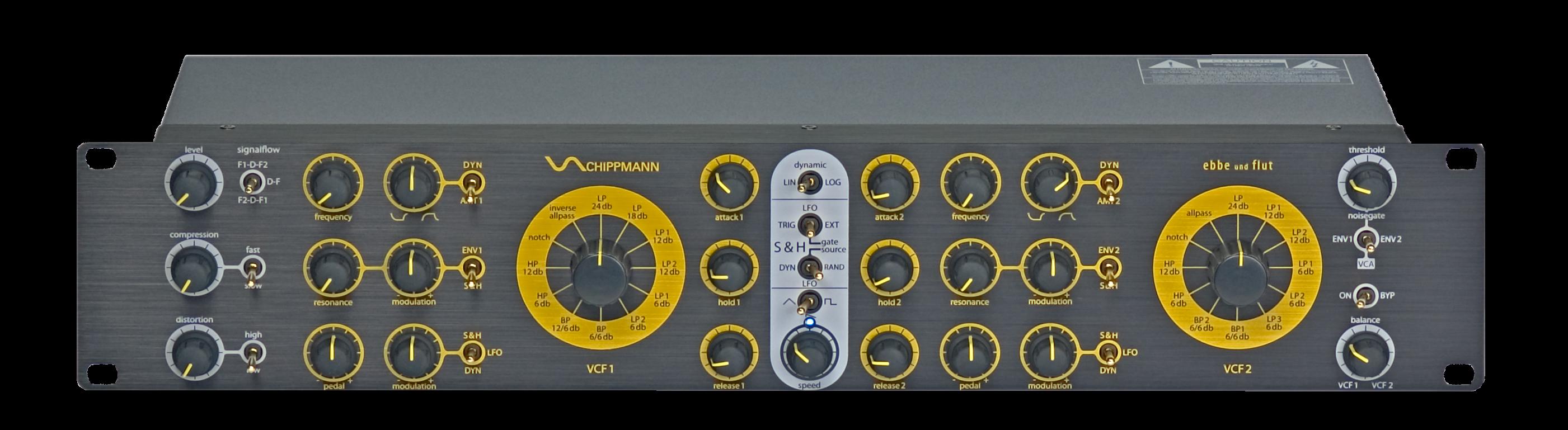
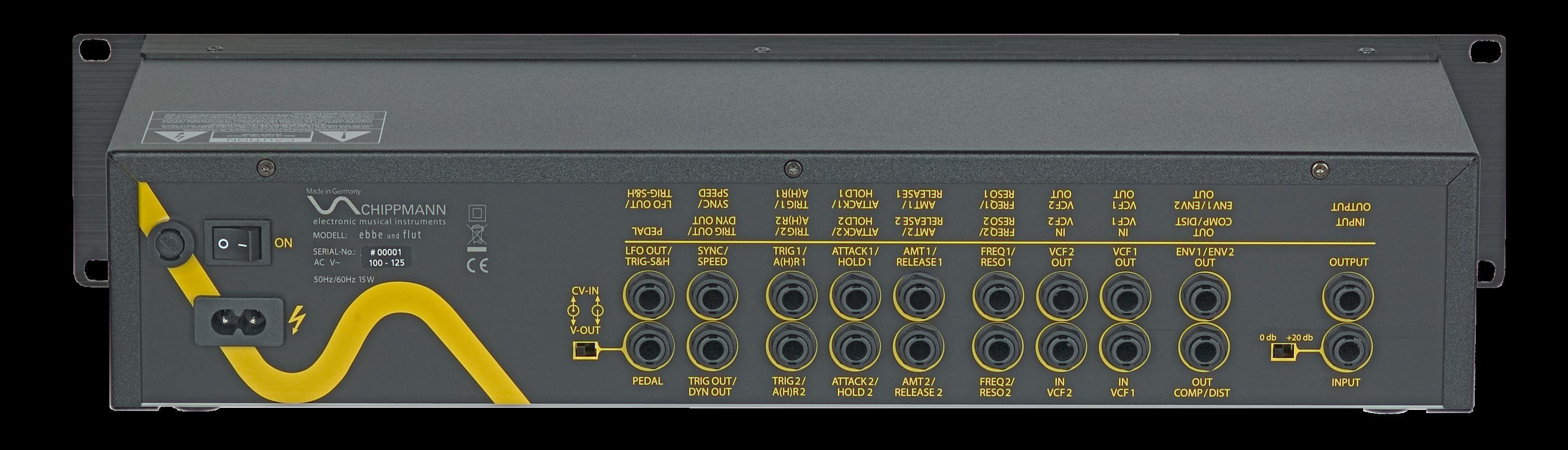
About the serial-no.: They are subdivided into even numbers (230 V power) and odd ones (115 V power).
Moreover, there are some MK II units circulating, which are not labeled as MK II with the following serial-no.:
- 115 V (odd) : 147 - 255 (147, 149, 151,. . .), 55 units overall
- 230 V (even): 160 - 492 (160, 162, 164,. . .), 167units overall
- later upgraded MK I units to MKII:
- odd: 103, 125, 127, 133-143
- even: 44, 56, 124, 134
Arduino based LFO+ADSR, controlled through Ableton with Max for Live
ebbe und flut - fully analogue integrated modular sound-design-machine/channel-strip
- two different 4-pole super-sonic multimode VOLTAGE CONTROLLED FILTERS (VCF's) with 12
characteristics each (lowpass, highpass, bandpass, notch, allpass)
and with an extreme tonal range
- completed by an easy controllable superb COMPRESSOR,
a sweet sounding
2-way spectral DISTORTION unit and a final VCA
- all surrounded by a lot of very wide range voltage controlled MODULATORS
(high speed VC-LFO, 2x high range VC-AHR (Attack-Hold-Release) - ENVELOPES,
super fast RMS-VOLTAGE-FOLLOWER (logarithmic/linear scale),
a S&H and a NOISEGATE.
- A N D the very fast high precision AUDIO-TRIGGER is able to derive absolute reliable triggers for gating,
synchronizing and controlling other modules like ENV's, LFO, S&H or external stuff - capable to produce
perfect in-time rhythmic and synchronous modulations
according to your music data input - very sensitive and independend on the input level.
The sound is absolute fantastic, warm and enormous powerful.
ebbe und flut is capable to turn every sound source by quantum leaps into new dimensions.
With analogue instruments, nature is talking to us!
Modules & Features:
-Input Amplifier (0db/+20db)
-Automatic Softknee Compressor (Attack/Release times: 20 ms/125 ms or 40 ms/250 ms)
-2-way spectral Distortion with two change over frequencies (96 Hz/ 1050 Hz)
-quick Signalflow change (parallel/serial/anti-serial mode of VCF1, VCF2, Distortion)
-2 x VCF with 12 filter functions each (6xlowpass, 2xhighpass, 2xbandpass, notch, allpass)
-VCA
-VC (Voltage Controlled)- high speed LFO
-Sample & Hold (S&H)
-true RMS Voltage Follower (linear/logarithmic (db-linear) scale)
-2 x VC-(Voltage Controlled)-Envelope Generators (Attack/Hold/Release or Attack/Release)
-dynamic (level independent) Audiotrigger
-Noisegate
-Bypass
Rear panel audio ins and outs:
-Main Input
-Main Output (VCA/Noisegate)
-VCF 1 Audio Input
-VCF 1 Audio Output
-VCF 2 Audio Input
-VCF 2 Audio Output
-Compressor Output
-Distortion Output
Rear panel controller outs:
-Voltage Follower Output
-LFO Wave Output
-ENV 1 Output
-ENV 2 Output
-Audiotrigger Gate Output
Rear panel controller ins:
-VCF 1 Cutoff frequency CV-Input (0.5 V/oct.)
-VCF 1 Resonance CV-Input
-VCF 2 Cutoff frequency CV-Input (0.5 V/oct.)
-VCF 2 Resonance CV-Input
-Pedal Input; provides independent cutoff modulation (pos./neg.) for each filter,
works with passive volume pedal or active CV pedal,
switch for exchangable polarity of tip and ring for fitting with different brands
-LFO Speed CV-Input (<0.004 Hz - 19 kHz (29 kHz sawtooth), range = 1:5 million)
-LFO Sync. Input
-S&H Trigger Input
-ENV 1 Trigger/ Gate Input
-ENV 1 Attack Time CV-Input (<250 µs - 10 minutes, range = 1:2.5 million)
-ENV 1 Hold Time CV-Input (50 µs - 10 minutes, range = 1:12 million)
-ENV 1 Release Time CV-Input (350 µs - 10 minutes, range = 1:1.7 million)
-ENV 1 Amount CV-Input (bipolar multiplication Input for continous pos./neg. Env-Output)
-ENV 1 Mode Control Input (A-H-R (Trigger control) or A-R (direct Gate control) mode)
-ENV 2 Trigger/ Gate Input
-ENV 2 Attack Time CV-Input (<250 µs - 10 minutes, range = 1:2.5 million)
-ENV 2 Hold Time CV-Input (50 µs - 10 minutes, range = 1:12 million)
-ENV 2 Release Time CV-Input (350 µs - 10 minutes, range = 1:1.7 million)
-ENV 2 Amount CV-Input (bipolar multiplication Input for continous pos./neg. Env-Output)
-ENV 2 Mode Control Input (A-H-R (Trigger control) or A-R (direct Gate control) mode)